Supporting research

Supporting research / Research to explore

Historical evidence · Compiled 22 September 2026

What can other
schools teach us?

Closure proposals can be stopped. Use these records to strengthen the case for keeping Kew open. They cover 12 selected reprieve schools across nine decision episodes and four closure comparisons; they do not predict Kew’s odds of success.

Build a credible alternative. Fletching’s closure consultation halted after improved short-term finances, alongside a stable roll and diocesan support. Recurring deficits remained; its rural context differs from Kew.

Challenge gaps in the decision’s evidence. St John the Divine’s proposal was rejected over process and receiving-school sustainability. Its faith-school referral route is not an automatic appeal right for Kew parents.

Turn community support into useful evidence. Five proposals stopped in one Isle of Wight programme; Cowes closed. All six had petitions, so these records establish neither a petition effect nor a winning threshold.

Read the three lessons and their evidence

An alternative must withstand financial scrutiny

Outcome Fletching: Closure consultation halted in 2019. Broad Oak Community Primary School: School closed in 2020.

What the record supports Fletching’s short-term budget improved with largely one-off support. Its roll and the diocese’s position also supported the recommendation. Broad Oak’s revised federation budget still forecast a deficit, with concerns about leadership cover and pupil recruitment.

Fletching still expected recurring deficits, so the reprieve did not show long-term recovery. It is a rural school, unlike Kew.

Question for Kew · editorial interpretation Does the alternative work across every forecast year, with credible staffing, pupil demand and partner commitments?

Decision records and follow-up: S01 · S02 · S24 · G13

A challenge can change a decision—or improve transition

Outcome St John the Divine: Closure proposal rejected in 2025. St Bartholomew's CofE Primary School: Closure approved, with an extra term for transition; closed in December 2024.

What the record supports St John’s decision found process deficiencies. It also found too little evidence that pupil transfers would sustain the receiving school. St Bartholomew’s decision accepted closure but required more time for vulnerable pupils’ transition.

A delay is a different outcome from a reprieve. These faith-school referral routes are not an automatic right of appeal for Kew parents.

Question for Kew · editorial interpretation What specific concern needs checking, and what remedy would address it?

Decision records and follow-up: S08 · S23 · G14

Petitions accompanied different outcomes

Outcome Godshill, Brading, Oakfield, Wroxall and Arreton St George's: Five closure proposals stopped in 2024–25. Cowes Primary School: Also had a petition; closed in August 2025.

What the record supports Petitions were recorded for all six schools. The records do not measure their effect or show a winning signature threshold.

These schools were part of one local programme. The minutes do not give separate reasons for the Brading, Oakfield and Wroxall decisions.

Question for Kew · editorial interpretation Could community support help find useful evidence, relevant expertise or credible commitments?

Decision records and follow-up: S03 · S05 · S07 · S27 · S28 · G12

Use the research in a question
Research contents and downloads
Explore eight graphics

Eight ways to understand the evidence

Choose a question to explore.

Start with the decision reasons, funding, practical work and closure comparisons. Each graphic includes readable data, evidence notes and a full-size download.

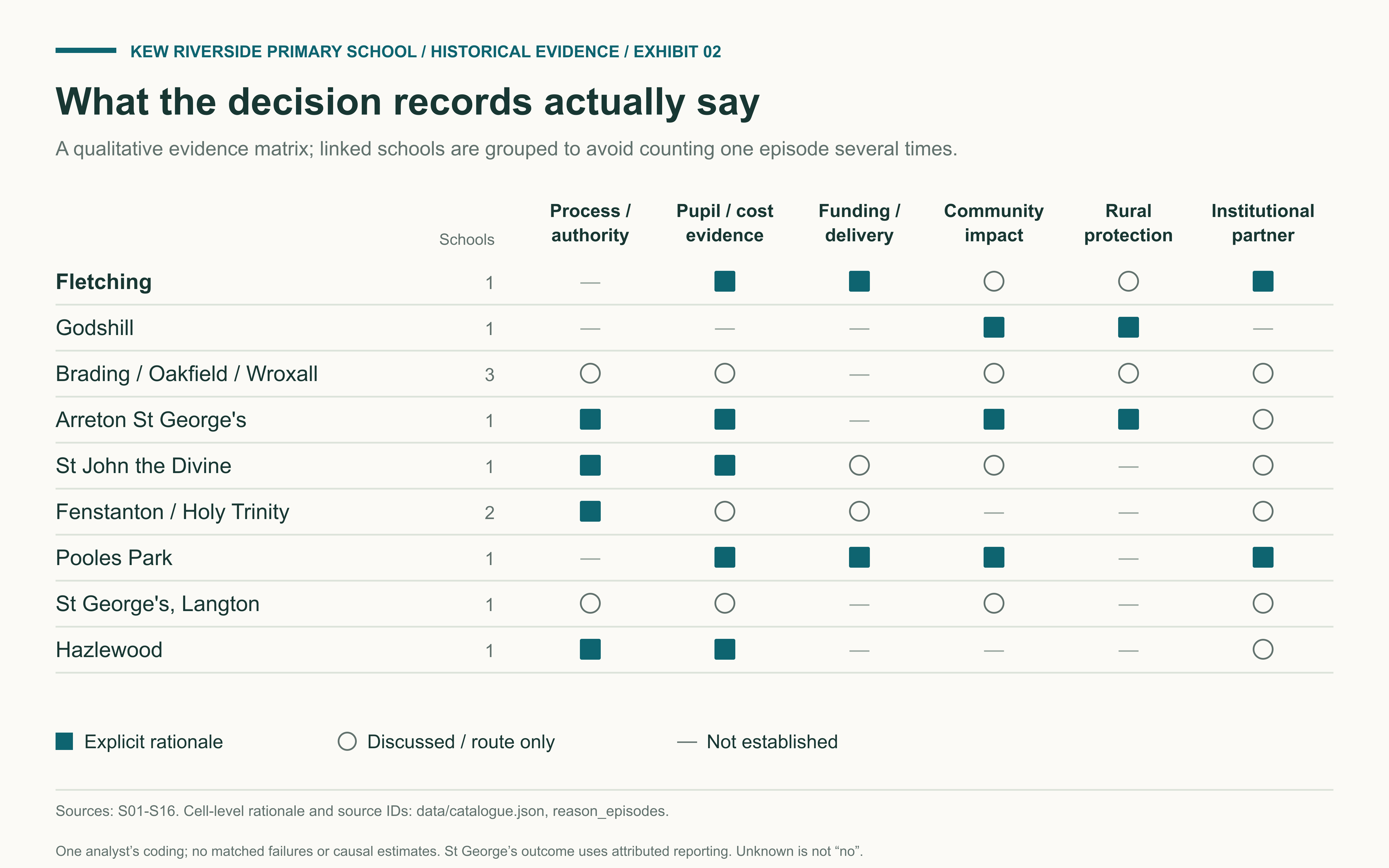
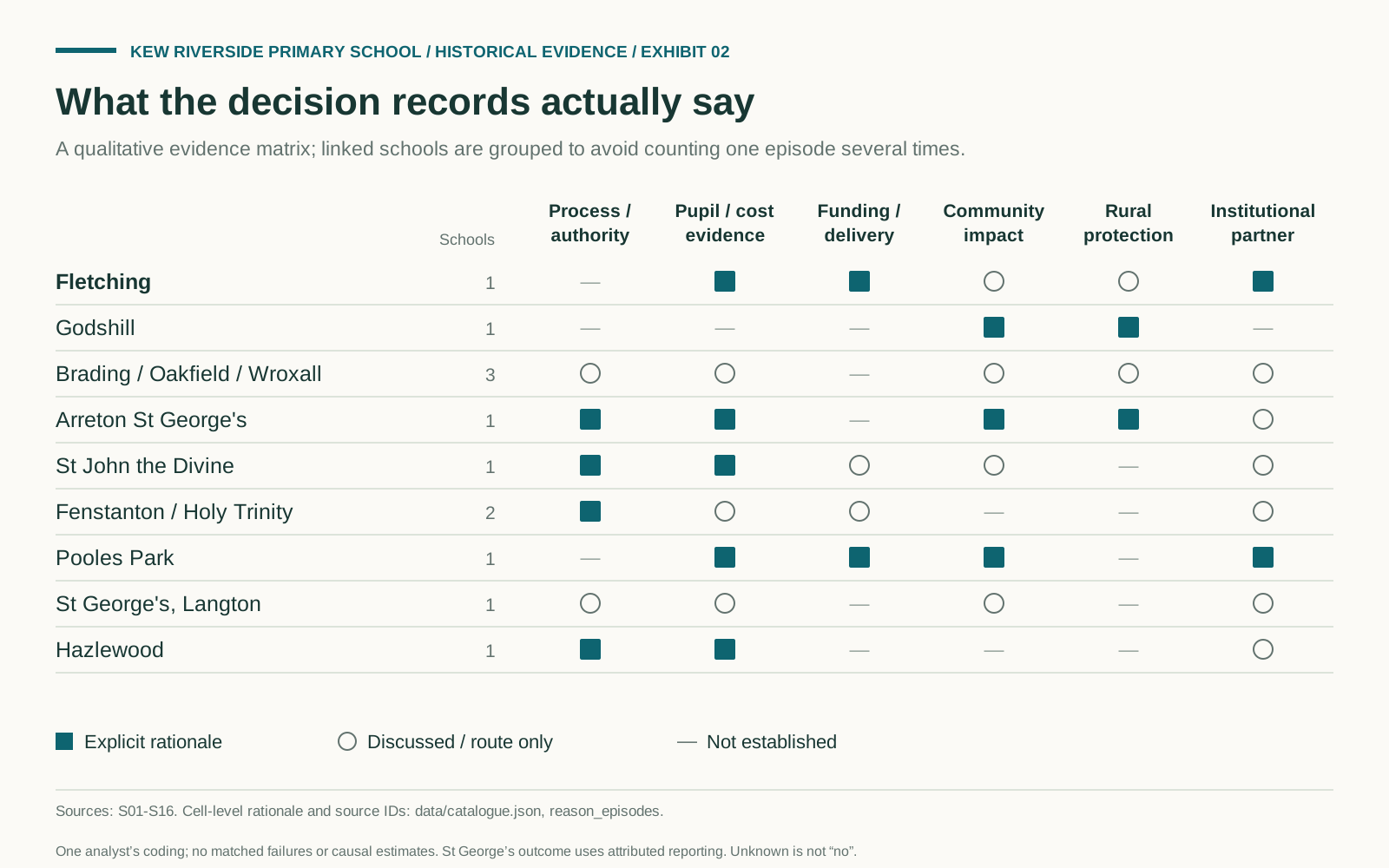
02What reasons appear in decisions?What the decision records actually say
Nine episodes are coded against six factors. Filled squares mean explicit decision rationale; outlined circles mean discussed or part of the route; dashes mean not established. Factors overlap and are not causal effect estimates.

Sources: S01 · S03 · S05 · S07 · S08 · S10 · S11 · S13 · S15. Evidence and interpretation.

Read the chart’s data and notes
Nine grouped episodes: overlapping reasons, coded by one analyst
Decision episodeSchoolsProcess / authorityPupil / cost evidenceFunding / deliveryCommunity impactRural protectionInstitutional partner
Fletching1Not establishedExplicit rationaleExplicit rationaleDiscussed / routeDiscussed / routeExplicit rationale
Godshill1Not establishedNot establishedNot establishedExplicit rationaleExplicit rationaleNot established
Brading / Oakfield / Wroxall3Discussed / routeDiscussed / routeNot establishedDiscussed / routeDiscussed / routeDiscussed / route
Arreton St George's1Explicit rationaleExplicit rationaleNot establishedExplicit rationaleExplicit rationaleDiscussed / route
St John the Divine1Explicit rationaleExplicit rationaleDiscussed / routeDiscussed / routeNot establishedDiscussed / route
Fenstanton / Holy Trinity2Explicit rationaleDiscussed / routeDiscussed / routeNot establishedNot establishedDiscussed / route
Pooles Park1Not establishedExplicit rationaleExplicit rationaleExplicit rationaleNot establishedExplicit rationale
St George's, Langton1Discussed / routeDiscussed / routeNot establishedDiscussed / routeNot establishedDiscussed / route
Hazlewood1Explicit rationaleExplicit rationaleNot establishedNot establishedNot establishedDiscussed / route

A blank or “not established” is not evidence that a factor was absent or ineffective. No independent second coding was performed.

Fletching: Recommendation expressly cites improved budget, stable roll and diocesan position (7.3). Community/rural issues were considered; they are not isolated as decisive in 7.3. S01 · S02

Godshill: Council explanation cites community, rural presumption and earlier local decisions. S03 · S04

Brading / Oakfield / Wroxall: Issues appear in the wider proceedings and diocesan account. Minutes do not explain why these three specific votes went against closure. No grounds are coded 2. S05 · S06

Arreton St George's: STP661 explicitly links significant procedural/evidential flaws and unassessed rural-community impact to rejection. Diocese made the referral. S07 · S06

St John the Divine: STP659 paragraph 61 states process deficiencies and failure to demonstrate the receiving school's sustainability. Mixed-age organisation and community services were discussed but not necessary to the conclusion. S08 · S09

Fenstanton / Holy Trinity: STP662 rejects both proposals on procedural and jurisdictional grounds. Merger budget/alternative was not validated; diocesan referral provided the route. S10

Pooles Park: Minister's recorded rationale includes viability assessment, a strong sponsor and SEND/community benefits (judgment 52-53). S11 · S12

St George's, Langton: Secondary reports record feedback and objections. No independently examined decision rationale, so no factor is coded 2. S13 · S14

Hazlewood: Proposed mechanism could not create the intended merged school. Capital difficulties remained; future closure was contemplated (67-74). S15

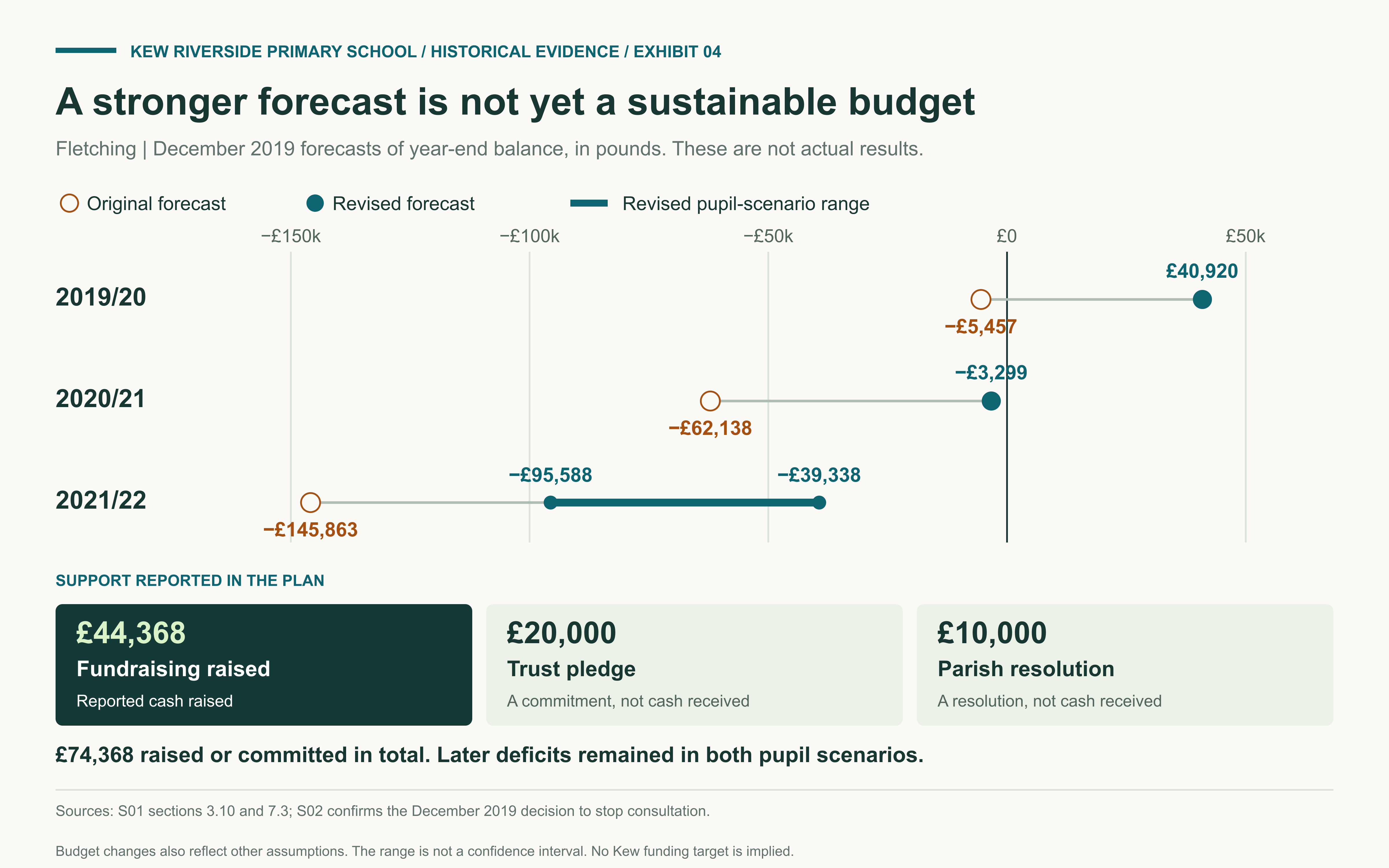
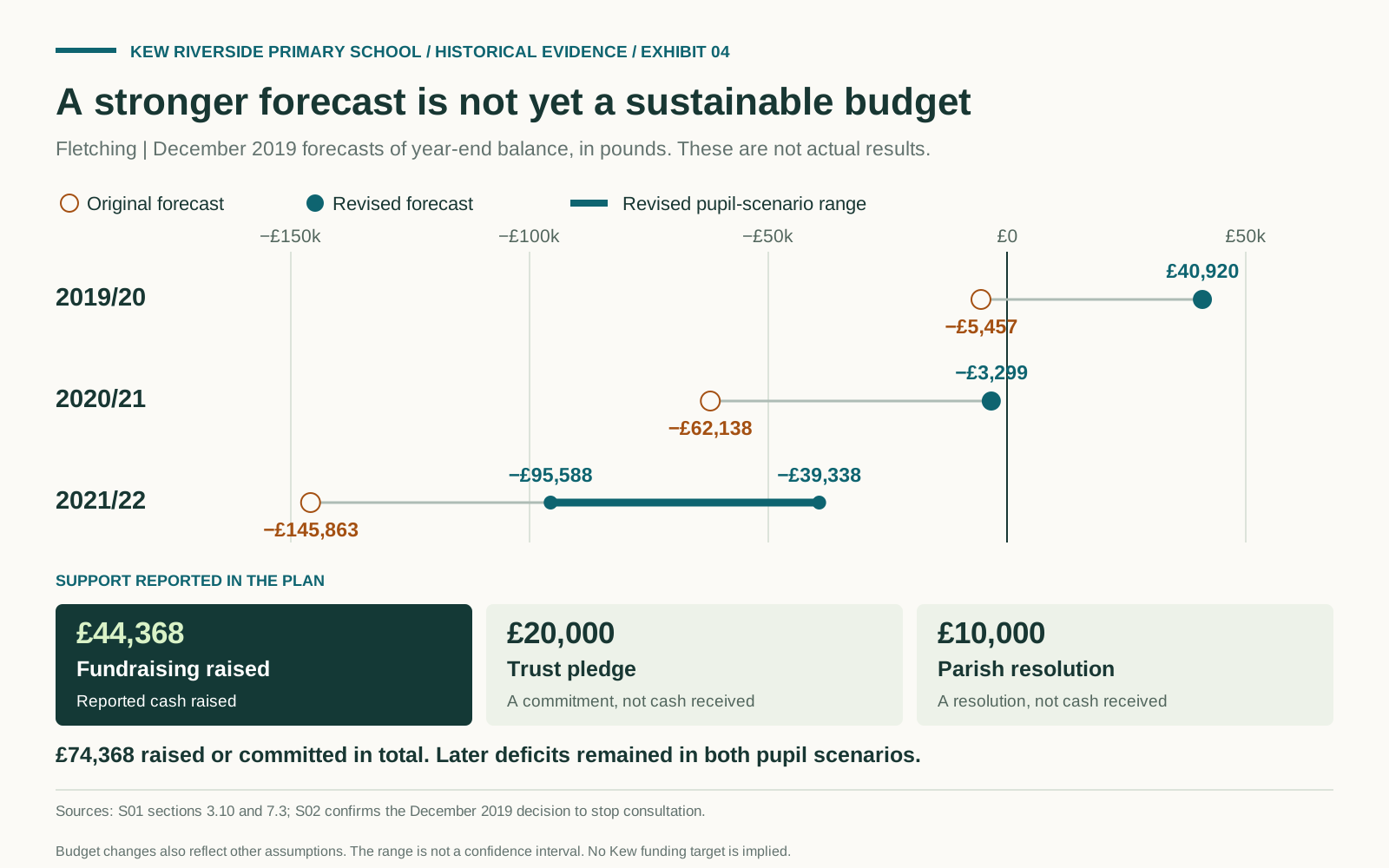
04Can funding buy time without fixing a deficit?A stronger forecast is not yet a sustainable budget
Original forecasts were minus £5,457, minus £62,138 and minus £145,863. Revised forecasts were £40,920, minus £3,299 and between minus £95,588 and minus £39,338. Support comprised £44,368 raised, £20,000 pledged by a trust and a £10,000 parish resolution.

Sources: S01 · S02. Evidence and interpretation.

Read the chart’s data and notes
Fletching forecast year-end balances; not annual losses or actual results
YearOriginal forecastRevised: optimistic pupilsRevised: cautious pupils
2019/20−£5,457£40,920£40,920
2020/21−£62,138−£3,299−£3,299
2021/22−£145,863−£39,338−£95,588

Support: £44,368 fundraising raised; £20,000 trust pledge; £10,000 parish resolution. The £74,368 combined total is not all cash received. The forecast also reflects other assumptions; the third-year range is a pupil scenario, not a confidence interval.

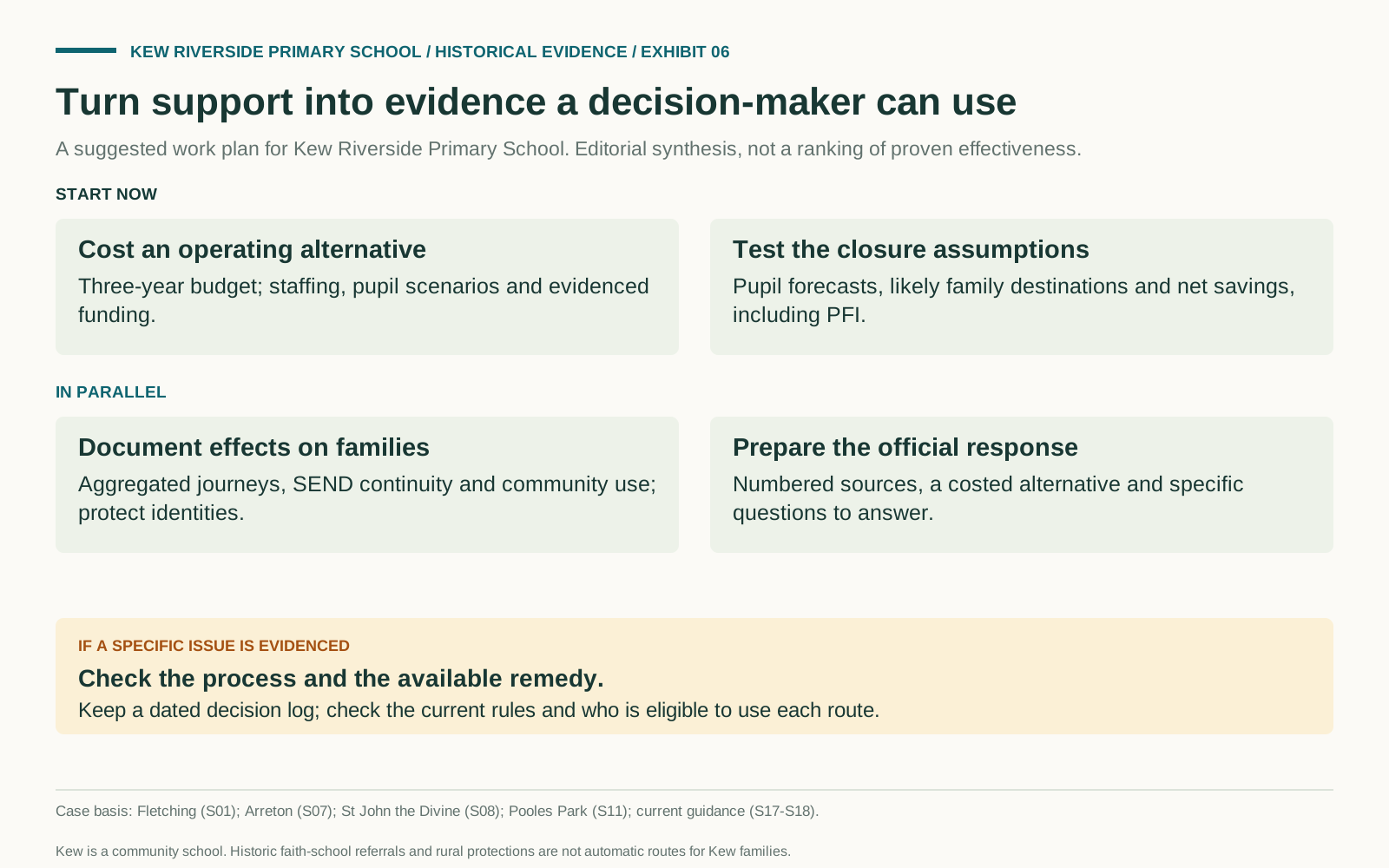
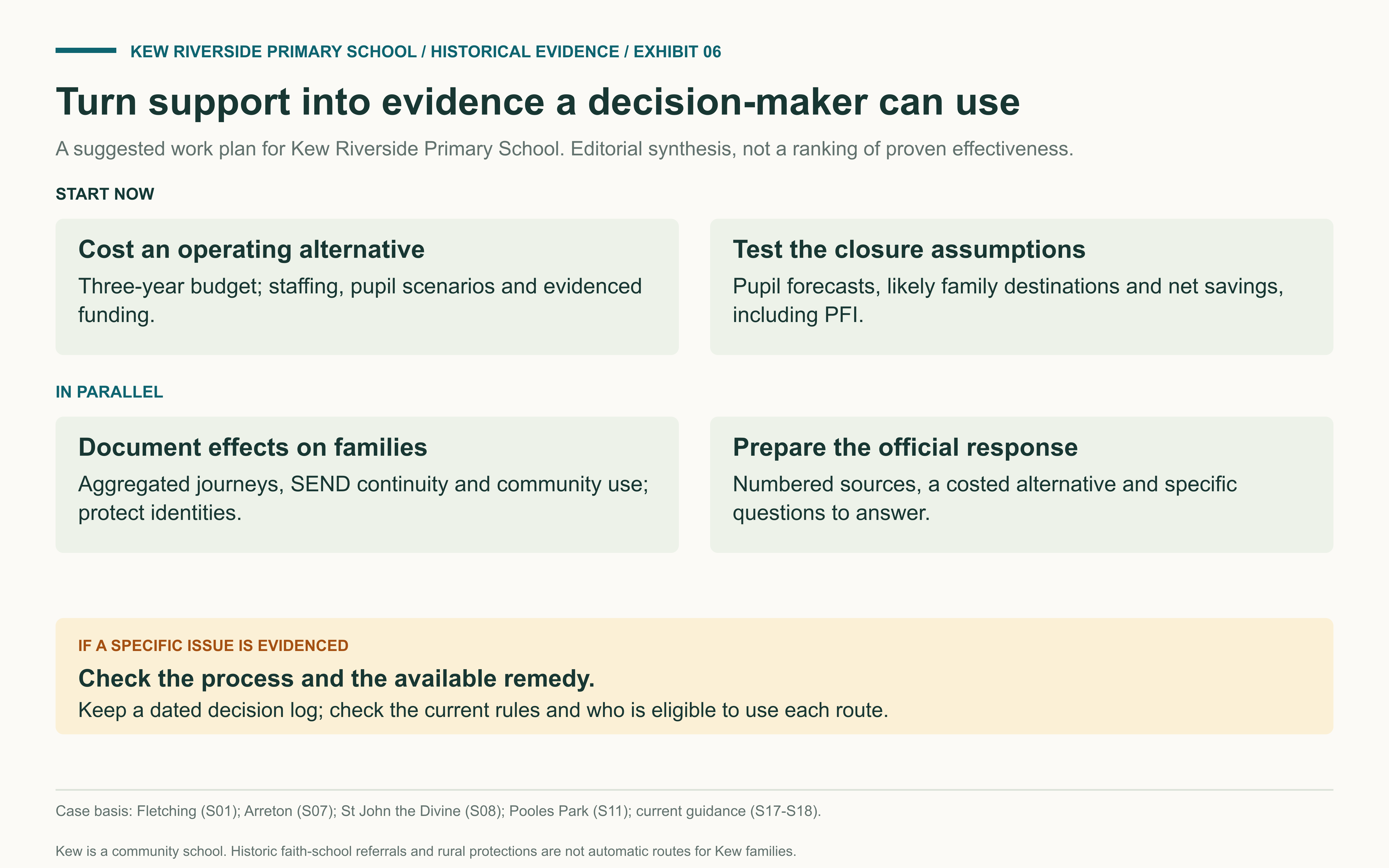
06What could we work on now?Turn support into evidence a decision-maker can use
Start a costed operating plan and audit demand and closure savings. In parallel document effects on families and prepare formal submissions. Seek specialist process advice if a specific issue is evidenced. Historical frequency does not estimate the impact of these actions.

Sources: S01 · S07 · S08 · S11 · S17 · S18 · S22. Evidence and interpretation.

Read the chart’s data and notes
Start now · Cost a smaller, sustainable school
Three-year budget; staffing and class options; low, central and high pupil scenarios; confirmed bridge funding and delivery partner.
Start now · Audit demand and the net saving
Traceable pupil forecasts, family destination evidence, transition costs and continuing building/PFI costs.
Alongside · Document what families would lose
Aggregated evidence on journeys, SEND continuity, nursery/community use and parental preferences; no public personal data.
Alongside · Turn support into formal evidence
Concise consultation submission with numbered evidence, costed alternatives and questions that need answers; work with governors.
If evidenced · Check process and available remedies
Dated decision log and specific concerns about process; check whether the school type is eligible before relying on a referral route.

Suggested priorities are editorial judgement, not measured effectiveness. Kew is a community school; historic faith-school referral routes and rural protections must not be assumed to apply.

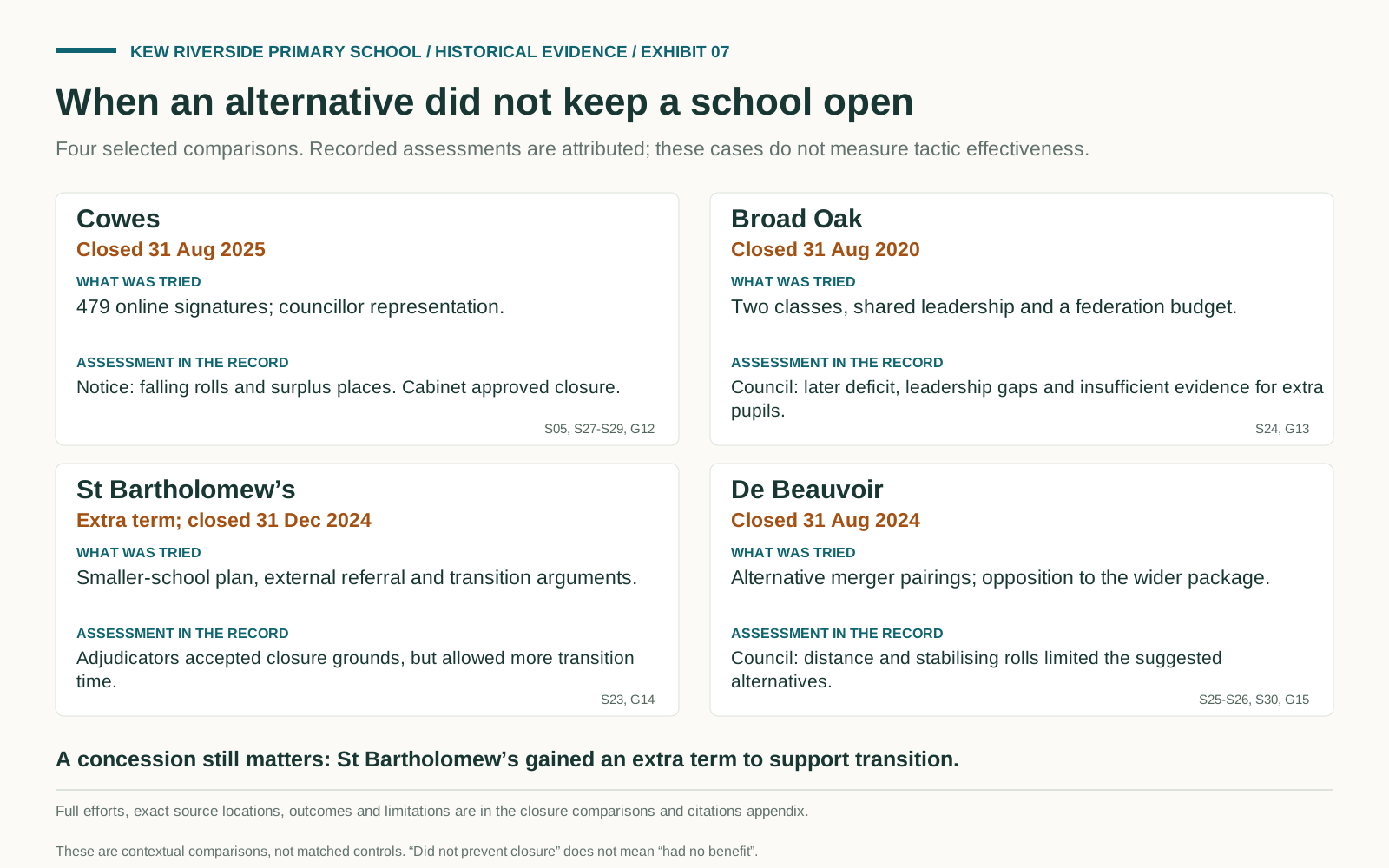
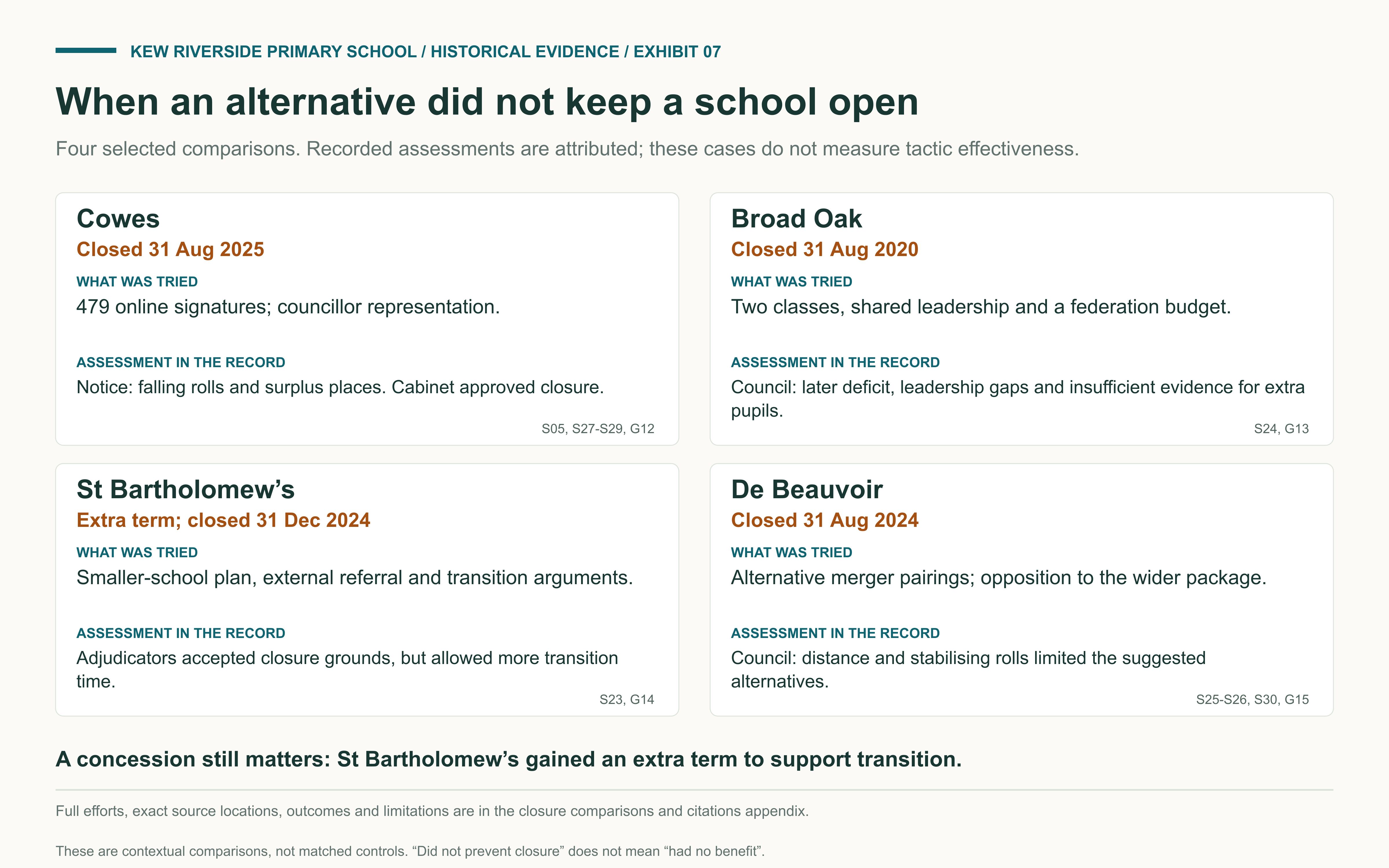
07Why did some alternatives fall short?When an alternative did not keep a school open
Cowes had a petition and councillor representation but closed. Broad Oak submitted a federation budget, rejected on financial and delivery grounds. St Bartholomew’s proposed a smaller school and pursued adjudication; it obtained one extra term, then closed. De Beauvoir merger suggestions and wider opposition did not change the council’s conclusion. These are case observations, not estimates of tactic effectiveness.

Sources: S23 · S24 · S25 · S27 · G12 · G13 · G14 · G15. Evidence and interpretation.

Read the chart’s data and notes
  • Cowes Primary School: Closure approved by Cabinet; GIAS confirms closure on 31 August 2025. The reviewed sources do not show any specific concession that can be credited to these efforts. Read the case and its limits
  • Broad Oak Community Primary School: March 2020 report recommended closure after examining the governors' alternative; GIAS confirms closure on 31 August 2020. The governors' plan received a documented assessment of its finances and operations. This does not prove any concession on the outcome. Read the case and its limits
  • St Bartholomew's CofE Primary School: Adjudicators approved closure with a one-term extension, from 31 August to 31 December 2024. GIAS confirms the later closure date. One extra school term for transition, explicitly justified by the adjudicators. This is a meaningful concession, not a lasting reprieve. Read the case and its limits
  • De Beauvoir Primary School: Cabinet agreed closure in December 2023; GIAS confirms closure on 31 August 2024. The reviewed sources do not show any specific reprieve or transition concession that can be credited to these submissions. Read the case and its limits
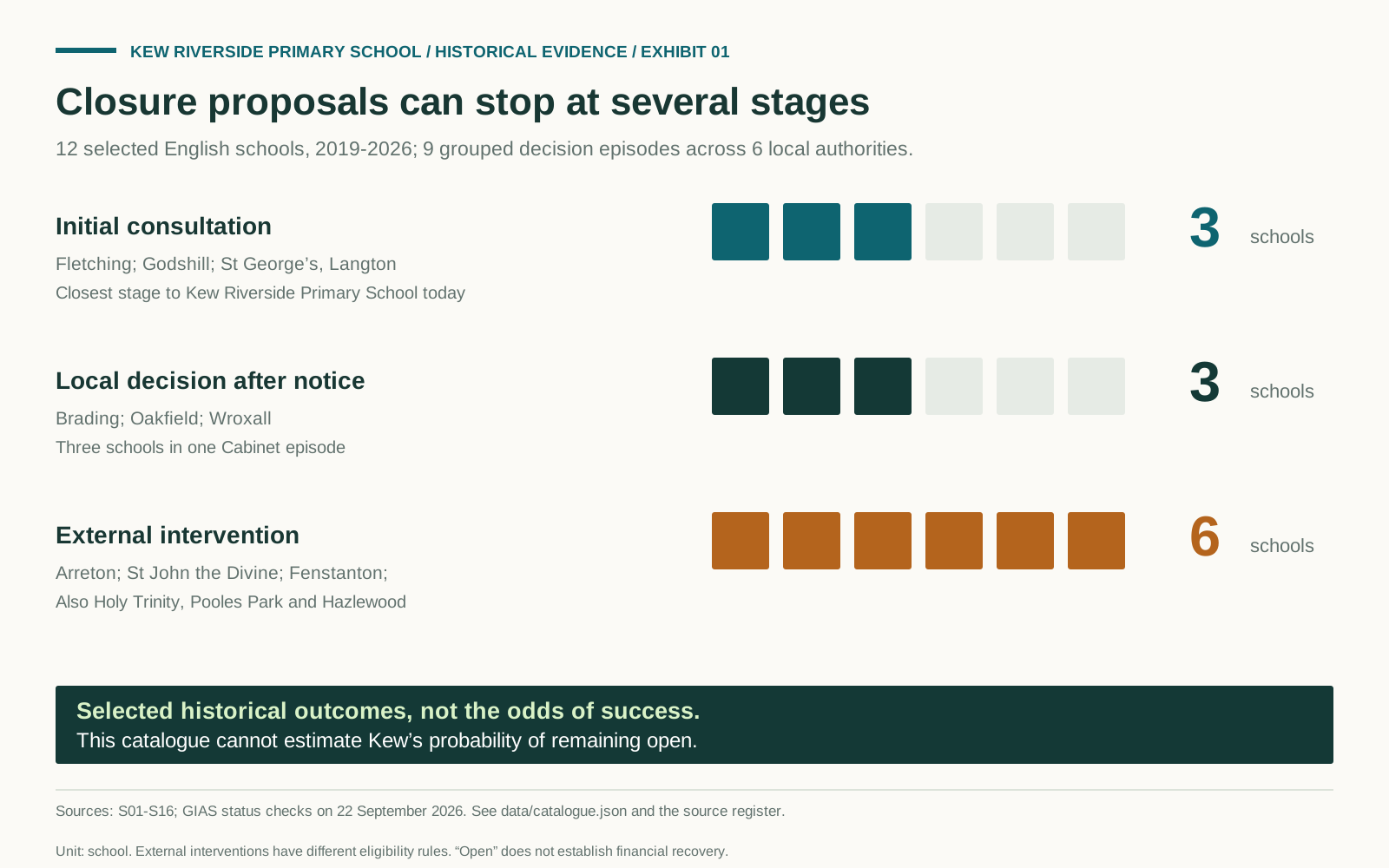
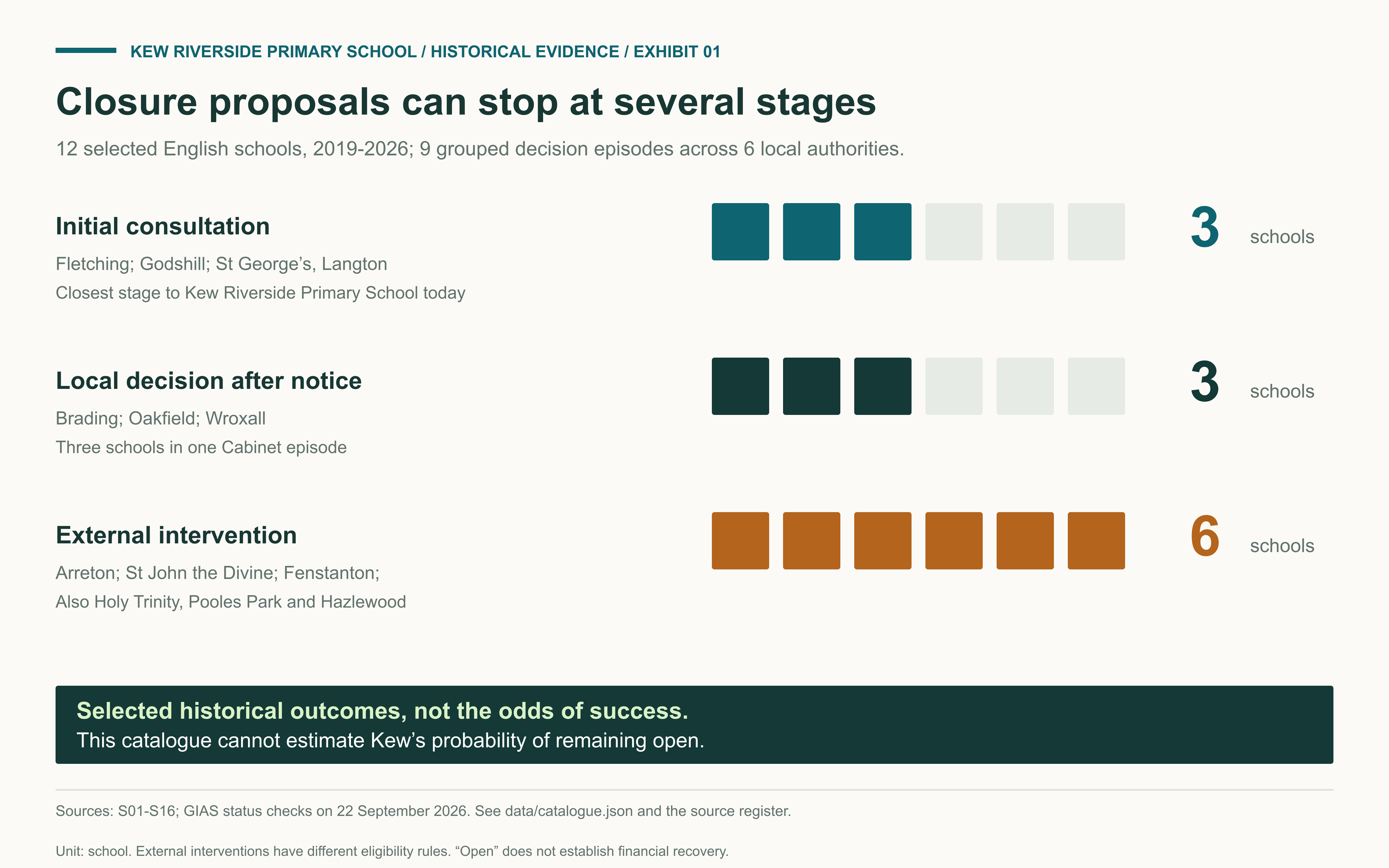
01Where did proposals stop?Closure proposals can stop at several stages
Three schools were retained during initial consultation, three at a local decision after statutory notice, and six following external intervention. These are counts within a selected catalogue, not national success rates.

Sources: S01 · S03 · S05 · S07 · S08 · S10 · S11 · S13 · S15. Evidence and interpretation.

Read the chart’s data and notes
12 selected schools; not national success rates
Stage where proposal stoppedSchoolsNames
Initial consultation3Fletching; Godshill; St George’s, Langton
Local decision after notice3Brading; Oakfield; Wroxall
External intervention6Arreton; St John the Divine; Fenstanton; Holy Trinity; Pooles Park; Hazlewood
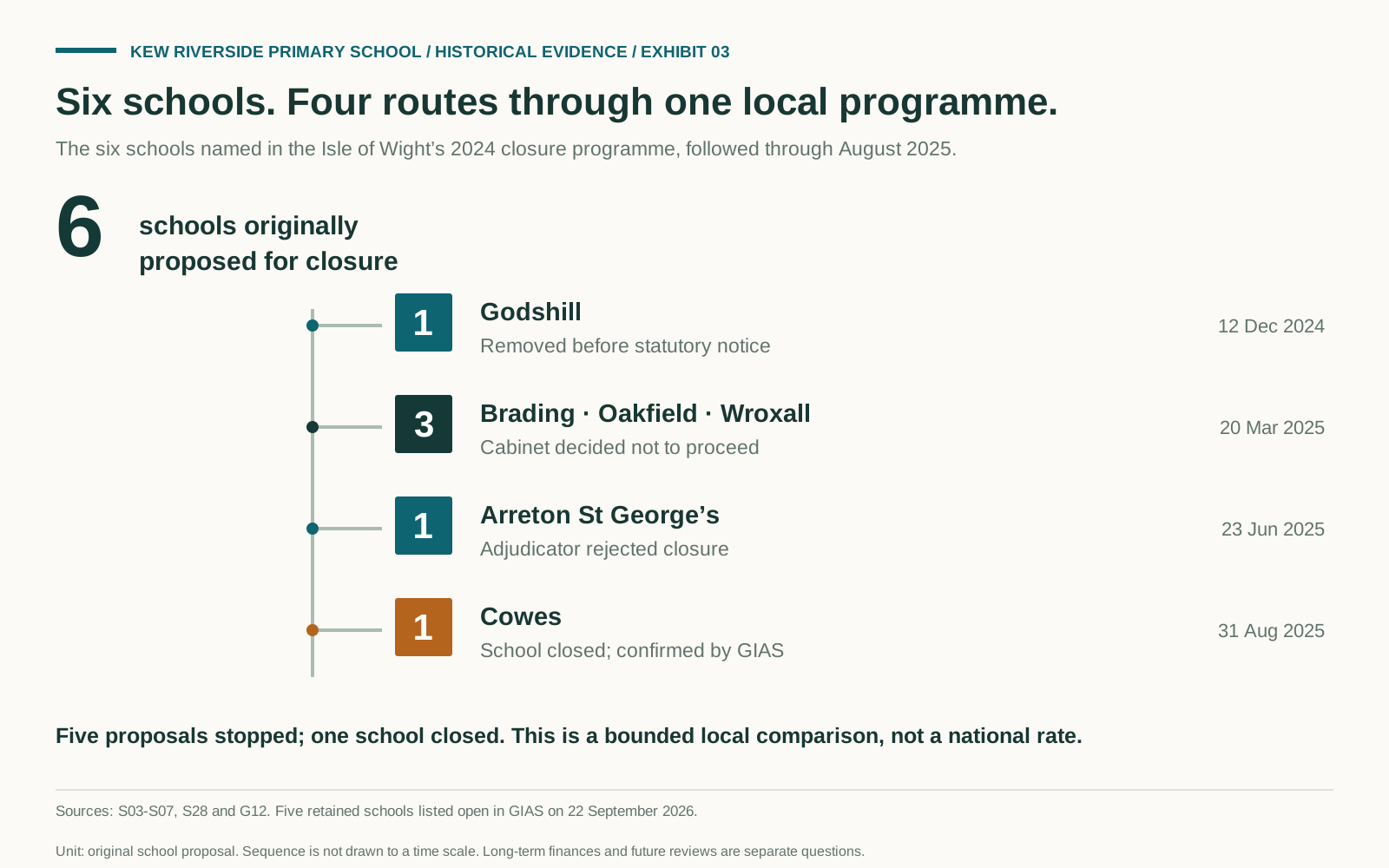
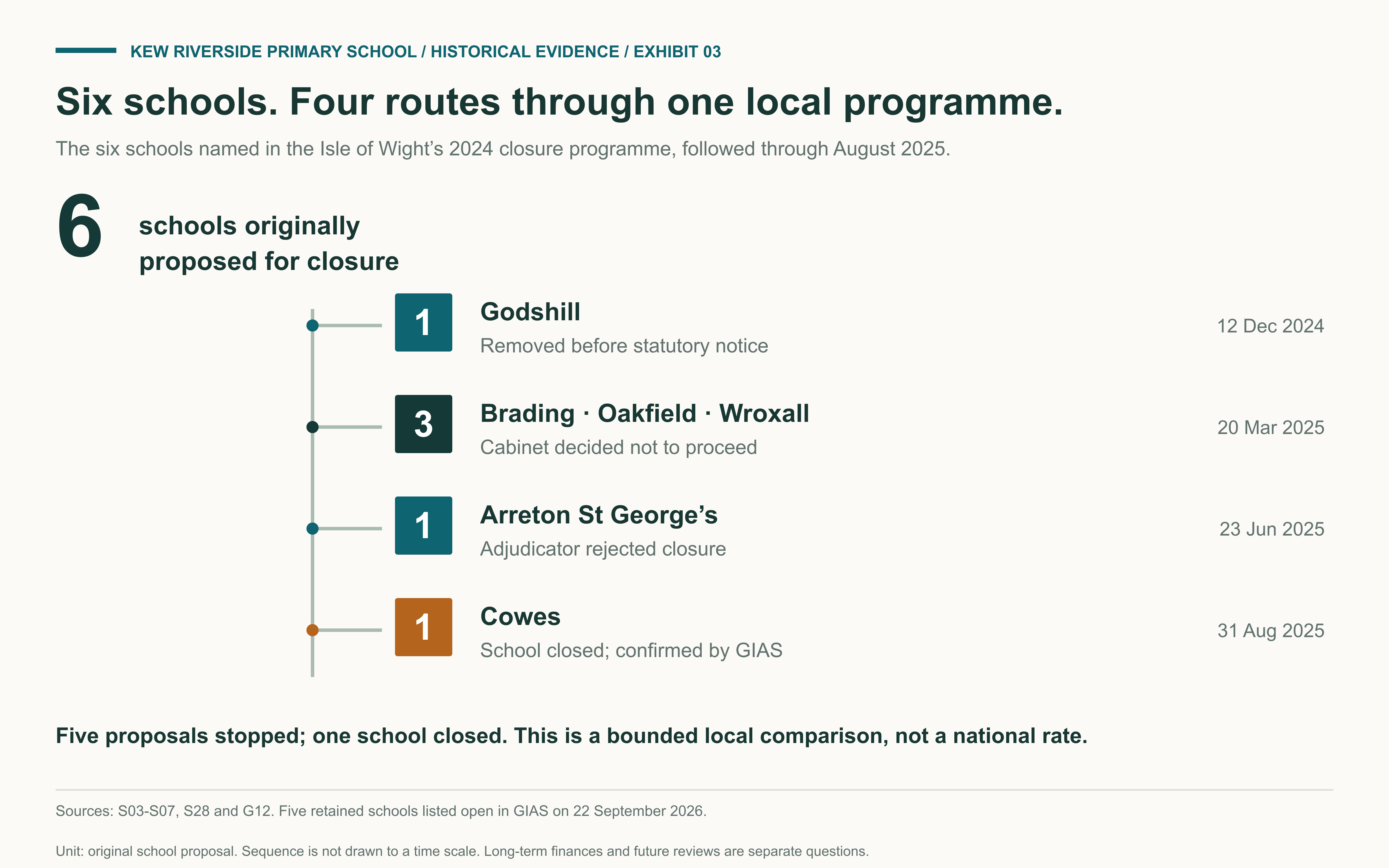
03What happened to one whole local group?Six schools. Four routes through one local programme.
Of six schools, Godshill was removed before statutory notice; Brading, Oakfield and Wroxall were retained by Cabinet; Arreton was retained after adjudication; Cowes closed on 31 August 2025. This local cohort is not representative of England.

Sources: S03 · S05 · S07 · S28 · G12. Evidence and interpretation.

Read the chart’s data and notes
All six original Isle of Wight proposals; one local programme
School(s)Decision / outcome dateOutcome
Godshill12 December 2024Removed before notice
Brading; Oakfield; Wroxall20 March 2025Cabinet did not proceed
Arreton23 June 2025Closure rejected by adjudicator
Cowes31 August 2025School closed
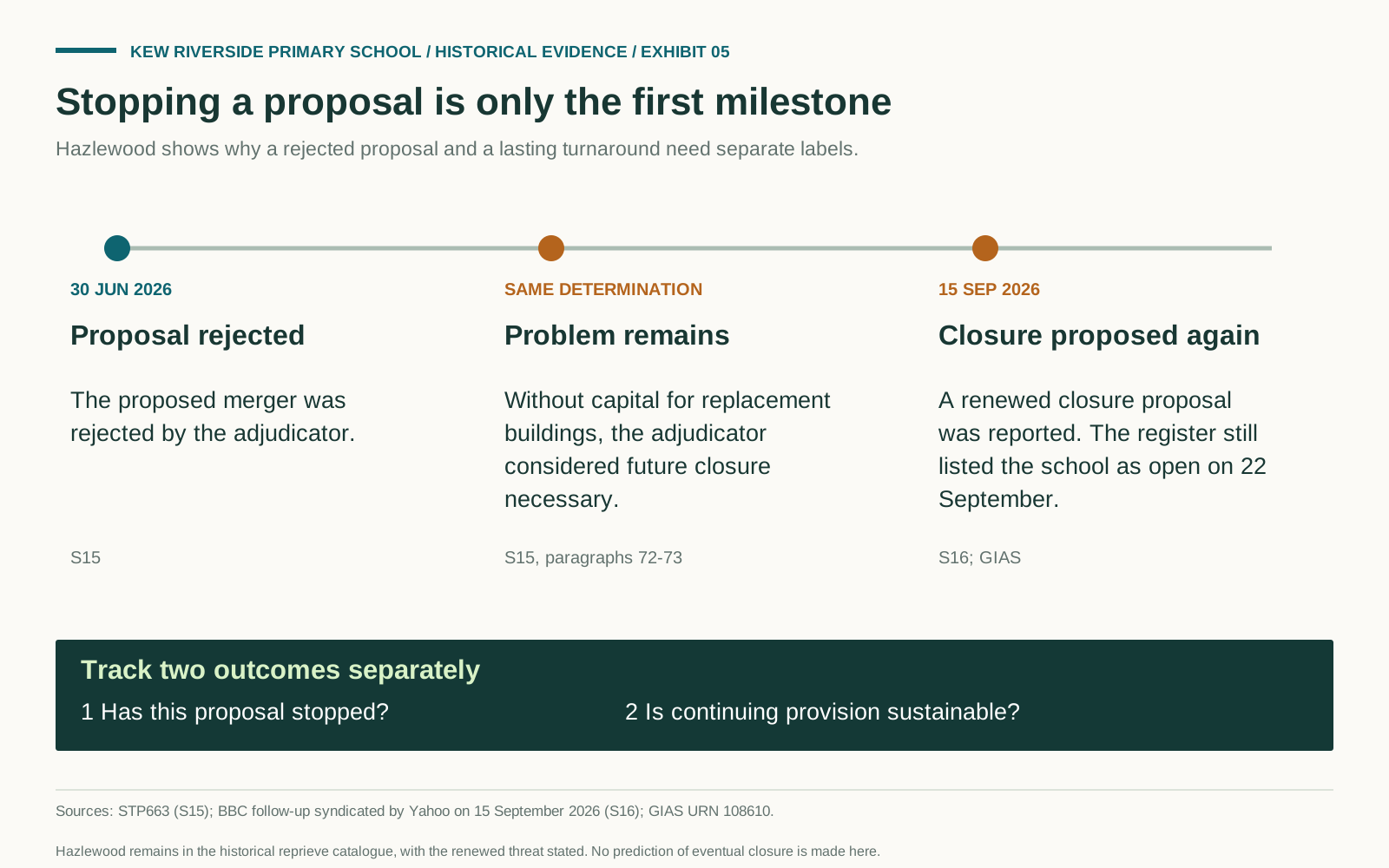
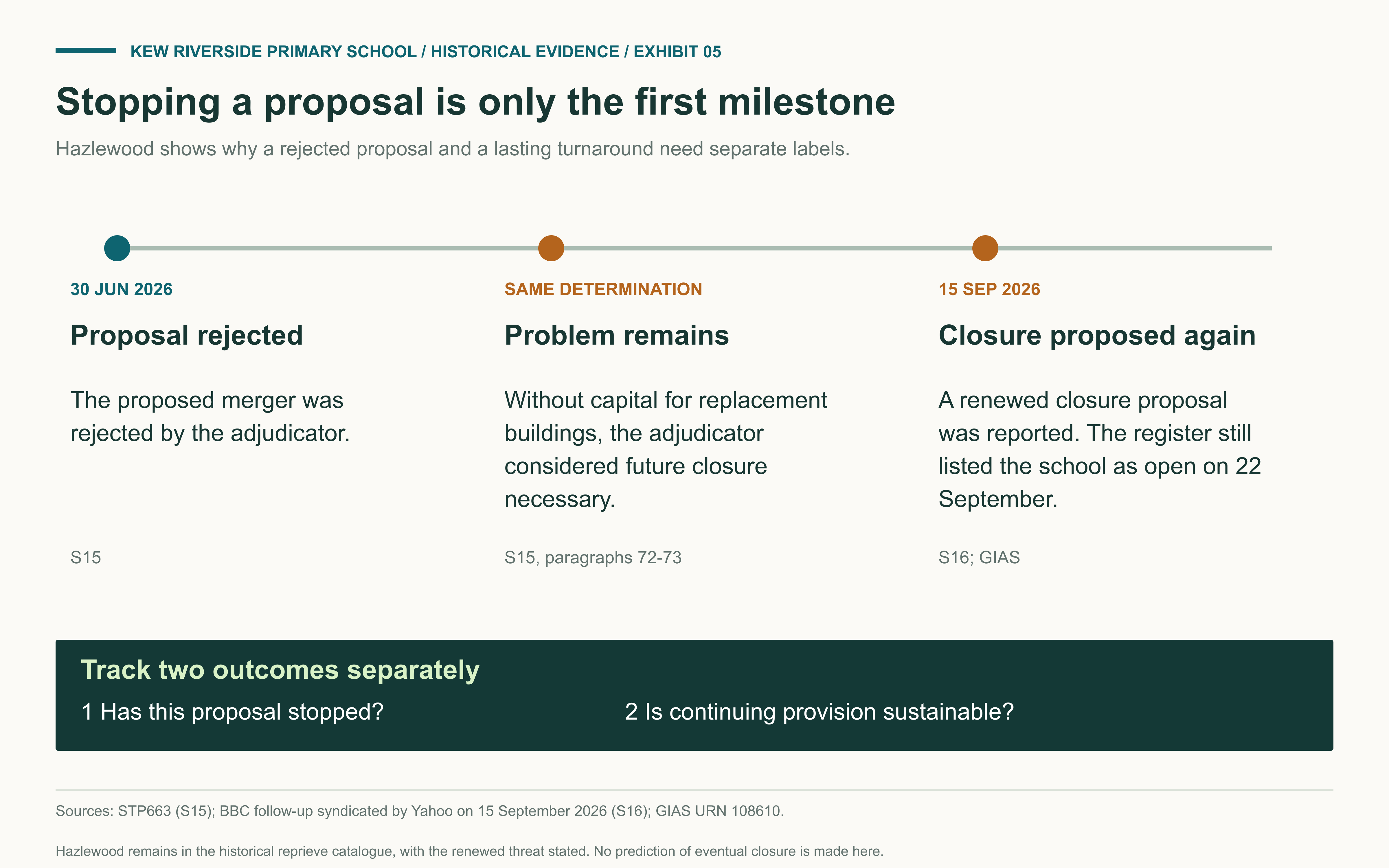
05Does a reprieve mean recovery?Stopping a proposal is only the first milestone
On 30 June 2026 the adjudicator rejected the Hazlewood merger proposal but said closure should follow without capital for replacement buildings. A renewed closure proposal was reported on 15 September 2026. The school remained open in GIAS on 22 September 2026.

Sources: S15 · S16 · G11. Evidence and interpretation.

Read the chart’s data and notes
  1. 30 June 2026: the Hazlewood merger proposal was rejected.
  2. Same determination: capital for replacement buildings remained an unresolved problem; the adjudicator contemplated future closure.
  3. 15 September 2026: a renewed closure proposal was reported. The register listed the school open on 22 September.

Track a stopped proposal separately from a viable long-term future. This research does not predict how Hazlewood’s case will end.

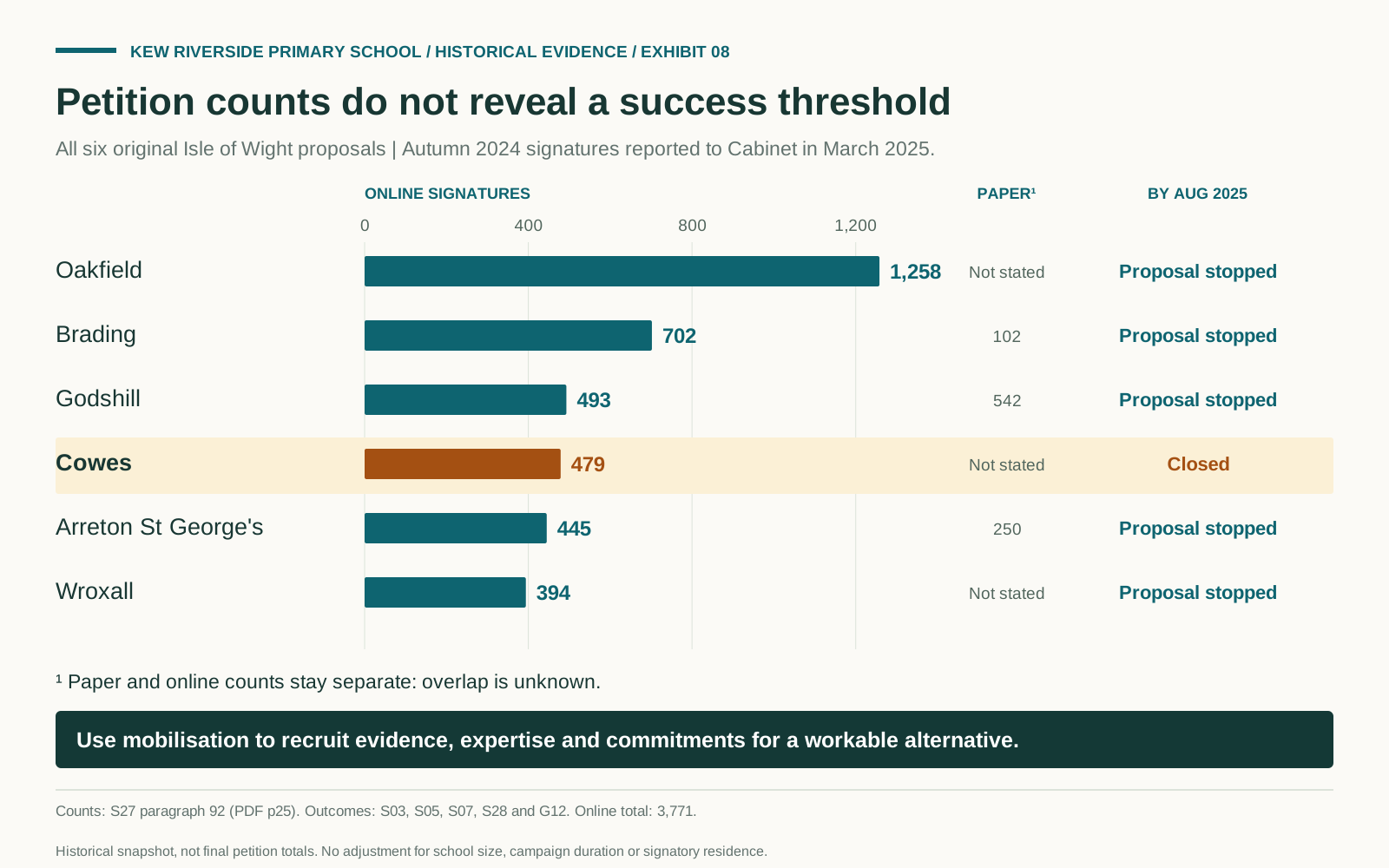
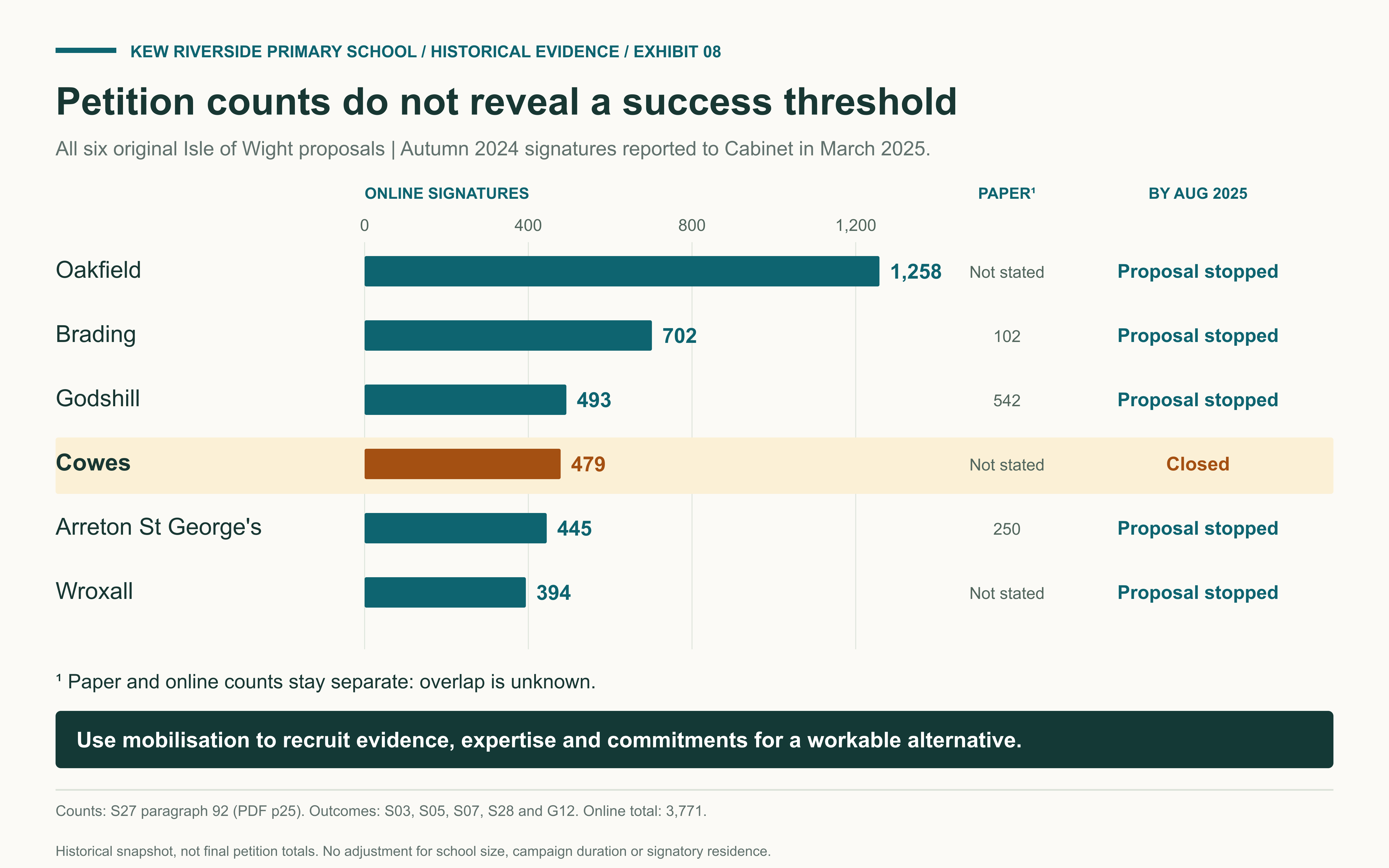
08What can petition counts tell us?Petition counts do not reveal a success threshold
Online petition counts were Oakfield 1,258, Brading 702, Godshill 493, Cowes 479, Arreton 445 and Wroxall 394. Cowes closed in August 2025; the other five proposals stopped. Paper signatures are recorded separately and not summed. The observations do not identify a petition’s causal effect or an effective threshold.

Sources: S27 · S03 · S05 · S07 · S28 · G12. Evidence and interpretation.

Read the chart’s data and notes
Autumn 2024 petition snapshot, reported March 2025
SchoolOnline signaturesPaper signatures (separate)Outcome by 31 August 2025
Oakfield1,258Not statedProposal stopped
Brading702102Proposal stopped
Godshill493542Proposal stopped
Cowes479Not statedSchool closed
Arreton St George's445250Proposal stopped
Wroxall394Not statedProposal stopped

Online total: 3,771. Paper signatures are not added because overlap is unknown. Counts are not adjusted for school size, campaign duration or signatory residence. This does not establish a causal effect or a signature threshold.

Browse all 16 schools

The complete catalogue

Read the case behind the lesson.

All 12 reprieve schools or successors were listed open in GIAS on 22 September 2026. Being “open” does not mean a school has recovered. Hazlewood faces a renewed proposal. Pooles Park continues through an academy successor. The four closure comparisons are selected for context, not a matched control group. Cowes is in both the local group and the comparisons, but it is one school.

16 schools shown · 12 reprieves and 4 closure comparisons

FletchingEast Sussex · 2019-12-23Consultation halted

Fletching Church of England Primary School

Primary decision / recommendation record · Voluntary controlled · Initial consultation

What the record supports
The council's recommendation relied on an improved short-term budget, a largely maintained roll and the diocese's position. Its subsequent admissions report confirms that closure did not proceed.
Application to Kew · editorial interpretation
Give the council a revised budget with evidenced funding and realistic pupil assumptions. Useful financial example; rural context differs from Kew.
Limits and follow-up
The council still expected recurring deficits and did not validate long-term recovery. Open in GIAS on 22 September 2026.

S01 · S02 · G01
S01 sections 3.10, 6.4 and 7.1-7.6; S02 section 2.3

GodshillIsle of Wight · 2024-12-12Removed before statutory notice

Godshill Primary School

Primary decision / recommendation record · Community · Initial consultation

What the record supports
Cabinet retained the school, citing community interests, the rural-school presumption and earlier decisions concerning Chillerton and Godshill.
Application to Kew · editorial interpretation
Link community evidence to the decision criteria and to the council's past commitments. Same community-school type, but the rural setting limits the comparison.
Limits and follow-up
The rural-school protection does not automatically apply to Kew Riverside Primary School. Open in GIAS on 22 September 2026.

S03 · S04 · G02
December Cabinet outcome; S04 response explaining Godshill's removal

BradingIsle of Wight · 2025-03-20Closure not pursued

Brading Church of England Controlled Primary School

Primary decision / recommendation record · Voluntary controlled · Local decision after statutory notice

What the record supports
Cabinet voted not to proceed. Published minutes record scrutiny and questions about costs and data, but do not isolate the reason for this school's outcome.
Application to Kew · editorial interpretation
Prepare evidence that members can use in scrutiny and the final decision. Relevant decision-making example; linked to the same local programme as four other entries.
Limits and follow-up
A campaign's presence does not establish that it caused the vote. Open in GIAS on 22 September 2026.

S05 · G03
Cabinet item 101a and item 104

OakfieldIsle of Wight · 2025-03-20Closure not pursued

Oakfield Church of England Aided Primary School, Ryde

Primary decision / recommendation record · Voluntary aided · Local decision after statutory notice

What the record supports
Cabinet voted not to proceed. The minutes document the outcome without a school-specific causal explanation.
Application to Kew · editorial interpretation
Use a clear evidence brief as well as taking part formally. The faith-school context differs, but preparing evidence is still relevant.
Limits and follow-up
It shares a Cabinet episode with Brading and Wroxall, so it does not count as a separate, independent result. Open in GIAS on 22 September 2026.

S05 · S06 · G04
S05 Cabinet item 101a; S06 account of the diocesan challenge

WroxallIsle of Wight · 2025-03-20Closure not pursued

Wroxall Primary School

Primary decision / recommendation record · Community · Local decision after statutory notice

What the record supports
Cabinet voted not to proceed. The minutes do not attribute that decision to a particular intervention.
Application to Kew · editorial interpretation
Find out what evidence decision-makers need before the vote. Same community-school type, but the island-wide context differs.
Limits and follow-up
The council said further school-place reviews would still be needed. Open in GIAS on 22 September 2026.

S05 · G05
Cabinet items 101a and 104

Arreton St George'sIsle of Wight · 2025-06-23Closure rejected by adjudicator

Arreton St George's Church of England (Aided) Primary School

Primary decision / recommendation record · Voluntary aided · External intervention

What the record supports
The adjudicators rejected the proposal because significant procedural flaws could have affected the outcome and the rural community impact had not been properly considered.
Application to Kew · editorial interpretation
Audit the selection method, evidence and community-impact assessment. The lessons on evidence are relevant, but referral rights and rural status need separate checks.
Limits and follow-up
The ruling stopped this proposal. It did not show permanent financial viability. Open in GIAS on 22 September 2026.

S07 · S06 · G06
STP661, paragraphs 132-133 and preceding analysis

St John the DivineLambeth · 2025-06-24Closure/merger proposal rejected

St John the Divine Church of England Primary School

Primary decision / recommendation record · Voluntary aided · External intervention

What the record supports
The adjudicator found deficiencies in the process and insufficient evidence that pupil transfers would produce a sustainable receiving school.
Application to Kew · editorial interpretation
Test what families actually prefer and the financial effects of pupils moving. A strong London example on demand and cost, but its governance differs from Kew.
Limits and follow-up
Mixed-age classes were discussed as a possible option, not an approved recovery plan. Long-term sustainability remained uncertain. Open in GIAS on 22 September 2026.

S08 · S09 · G07
STP659, paragraphs 44-61 and 68

FenstantonLambeth · 2025-07-17Closure proposal rejected

Fenstanton Primary School

Primary decision / recommendation record · Community · External intervention

What the record supports
The adjudicators rejected the closure and related amalgamation proposals because the decisions and procedures were unlawful.
Application to Kew · editorial interpretation
Keep a dated record of proposals, conditions, decisions and who has authority to make them. London community school, but part of linked proposals with a faith school.
Limits and follow-up
The alternative merger was also rejected. The result did not validate its business case or establish a general parental appeal right. Open in GIAS on 22 September 2026.

S10 · G08
STP662, paragraphs 29-39

Holy Trinity, Tulse HillLambeth · 2025-07-17Closure proposal rejected

Holy Trinity Church of England Primary School, Tulse Hill

Primary decision / recommendation record · Voluntary aided · External intervention

What the record supports
The same adjudication left both Holy Trinity and Fenstanton open after rejecting the linked proposals.
Application to Kew · editorial interpretation
Check the process and who has authority to decide, as well as any alternative proposal. London financial pressures are relevant, but the school type and linked proposal differ.
Limits and follow-up
This is one shared adjudication with Fenstanton, not a second independent success. Open in GIAS on 22 September 2026.

S10 · G09
STP662, paragraphs 29-39

Pooles ParkIslington · 2023-11-14Academy route retained; provision continued

Pooles Park Primary School

Primary decision / recommendation record · Community, with academy order · External intervention

What the record supports
The minister retained the academy order. The recorded rationale was a willing sponsor, a viable academy model and additional SEND provision and community benefits.
Application to Kew · editorial interpretation
An alternative needs a capable organisation willing to deliver it. London example of a deliverable alternative, with materially different statutory circumstances.
Limits and follow-up
The school changed governance. Its academy-order circumstances cannot be assumed for Kew. Academy successor open in GIAS on 22 September 2026.

S11 · S12 · S12
2024 High Court judgment, paragraphs 1 and 52-53; GIAS successor URN 150522

St George's, LangtonDorset · 2026-06-26Consultation stopped; two-year reprieve reported

St George's Church of England Primary School, Langton Matravers

Attributed reporting; no independently examined decision rationale · Academy · Initial consultation

What the record supports
News reports quote the trust ending consultation following feedback and ruling out structural changes in 2026/27 and 2027/28.
Application to Kew · editorial interpretation
Use early consultation to expose unanswered questions and seek a clear written response. Early-stage example; academy and rural setting differ.
Limits and follow-up
The outcome relies on news reports that quote the trust. Objections about process are not independent findings that anything was unlawful. Long-term options were still under review. Open in GIAS on 22 September 2026.

S13 · S14 · G10
Trust statements reported 26-27 June 2026

HazlewoodNorth Tyneside · 2026-06-30Merger rejected; renewed closure proposal reported

Hazlewood Community Primary School

Primary decision / recommendation record · Foundation (GIAS); OSA landing page labels community · External intervention

What the record supports
The adjudicator rejected the proposed merger but found that, without replacement-building capital, the school should eventually close.
Application to Kew · editorial interpretation
A reprieve on process grounds needs a plan for the underlying capital or running-cost problem. A useful warning about whether a reprieve lasts; its major building issues differ from Kew.
Limits and follow-up
A renewed closure proposal was reported on 15 September 2026. This has not been shown to be a lasting turnaround. Open in GIAS on 22 September 2026; renewed proposal reported.

S15 · S16 · G11
STP663, paragraphs 67-74; BBC syndicated report 15 September 2026

Cowes Primary SchoolIsle of Wight · Closed 2025-08-31Closure comparison

Closure approved by Cabinet; GIAS confirms closure on 31 August 2025.

What was tried

  • An online petition to save the school had 479 signatures in the council's reported initial-consultation snapshot. S27
  • The local councillor spoke on behalf of Cowes Primary at the Cabinet meeting before leaving the room for the decision. S05
Assessment in the record
The statutory notice cited declining pupil numbers at Cowes and significant surplus places in its planning area. Cabinet approved closure. The minutes do not establish the marginal effect of the petition or the councillor's intervention.
What changed
The reviewed sources do not show any specific concession that can be credited to these efforts.
Application to Kew · editorial interpretation
Public campaigning and political representation do not, on their own, show that the case on school places has changed. Link support to verifiable demand, costs and a deliverable alternative.
Comparison and limits
Same initial six-school programme as Godshill, Brading, Oakfield, Wroxall and Arreton. This comparison gives context; it is not a controlled experiment.
Evidence limitations
The signature count is a historical report snapshot, not the final campaign total or a count of affected families. No conclusion about what would have happened without the campaign is possible.

S05 · S27 · S28 · S29 · G12
S05 item 101a; S27 paragraph 92; S29 paragraphs 2-3; S28 action taken; G12 closure date

Broad Oak Community Primary SchoolEast Sussex · Closed 2020-08-31Closure comparison

March 2020 report recommended closure after examining the governors' alternative; GIAS confirms closure on 31 August 2020.

What was tried

  • Governors submitted a plan for two classes, restructured leadership and a pooled three-school federation budget. S24
  • The plan sought to build enrolment from 40-plus to 70-plus pupils during the next academic year. S24
Assessment in the record
The council's report found the pooled budget would still reach a £33,894 deficit in 2021/22. It questioned leadership capacity, absence cover and contingency, and regarded the extra-pupil target as insufficiently evidenced.
What changed
The governors' plan received a documented assessment of its finances and operations. This does not prove any concession on the outcome.
Application to Kew · editorial interpretation
Stress-test an alternative at both school and partner level: pupil recruitment, staffing, reserves, absence cover and the later years all need evidence.
Comparison and limits
Same authority and rural-school review period as Fletching. Fletching's proposal stopped in December 2019; Broad Oak's plan was assessed later and closure proceeded. The cases differ in finances, school type and education concerns.
Evidence limitations
The report gives the council's assessment of the alternative, not an independent forecast audit. Its concerns must not be recast as proof that federation or mixed-age teaching generally fails.

S24 · G13
S24 sections 12.1-12.13, 14-15; G13 closure date

St Bartholomew's CofE Primary SchoolBrighton and Hove · Closed 2024-12-31Closure comparison

Adjudicators approved closure with a one-term extension, from 31 August to 31 December 2024. GIAS confirms the later closure date.

What was tried

  • The school proposed reducing its admission number to 20 with staffing changes, and raised federation and phased closure as alternatives. S23
  • Governors referred the decision to the adjudicator. The school and diocese argued for more time to support vulnerable pupils' transition. S23
Assessment in the record
The adjudicators accepted the demographic need to reduce places and considered the deficit, low pupil numbers and concerns over a smaller school's delivery. They found the transition arrangements insufficiently developed for some vulnerable children and extended the timetable.
What changed
One extra school term for transition, explicitly justified by the adjudicators. This is a meaningful concession, not a lasting reprieve.
Application to Kew · editorial interpretation
A challenge may improve transition without preserving the school. Keep the case for a sustainable school and the case for protecting children during any transition explicit.
Comparison and limits
The same broad route, external adjudication, led to rejection at St John the Divine and to approval with a one-term extension here. The evidence and circumstances differed, so the difference cannot be put down to campaign quality.
Evidence limitations
The determination records the school as saying the diocese did not wish to pursue federation. Do not describe an agreed or funded federation as having been tested and failed.

S23 · G14
S23 paragraphs 2-3, 47-49 and 79-91; G14 closure date

De Beauvoir Primary SchoolHackney · Closed 2024-08-31Closure comparison

Cabinet agreed closure in December 2023; GIAS confirms closure on 31 August 2024.

What was tried

  • Consultation produced alternative merger pairings involving De Beauvoir, including Randal Cremer and Princess May. S25
  • Across the whole Hackney package, 95% of responses that could be clearly assessed opposed the proposals. This is a programme-wide figure, not a De Beauvoir-only result. S30
Assessment in the record
The council rejected suggested pairings on grounds including walking distance and whether pupil numbers would stabilise. It maintained that the underlying demand and sustainability problem remained despite extensive opposition.
What changed
The reviewed sources do not show any specific reprieve or transition concession that can be credited to these submissions.
Application to Kew · editorial interpretation
Set out a willing partner, viable combined rolls and a workable site and journey plan. Treat consultation support as evidence to go with that plan, not a vote that decides closure.
Comparison and limits
An urban community-school closure offers context for Kew. It is not matched on school finances, local geography or pupil demand.
Evidence limitations
The 95% figure is neither a representative public-opinion poll nor a school-specific percentage. The council's objections to these particular mergers do not show that all partnership options fail. S25 section 4.27 gives 207 opposed and 12 supportive proposal-level responses (219 clear responses, from a process receiving 175 submissions). A respondent could comment on several proposals; these are not 219 unique people.

S25 · S26 · S30 · G15
S25 sections 4.24-4.28 and 7.10-7.15; S26 overview of decision; S30 consultation summary; G15 closure date

Method and limits

How to read this research

Keep the limits beside the lessons.

School types, places, dates and access to legal routes differ. The 12 reprieves come from nine grouped decision episodes, and some local decisions are still linked. Neither the cases nor the graphic order measure effectiveness.

Read the complete method and evidence limitations

Research cutoff: 22 September 2026. Version 2.0.

This selection cannot show a national survival rate or the chance that Kew Riverside Primary School stays open.

What this catalogue contains

The catalogue covers twelve selected English state-funded primary schools. In each, a proposed closure or site merger stopped, or provision continued through an academy successor, in decisions between December 2019 and June 2026. All twelve successor/current URNs were checked directly against the Department for Education's Get Information about Schools (GIAS) register on 22 September 2026. All were listed open. Hazlewood has a renewed closure proposal reported in September 2026. An open register entry does not prove a sustainable budget, enrolment recovery or protection against a future proposal.

Four more closure comparisons are included: Cowes, Broad Oak, St Bartholomew's and De Beauvoir. All four closure dates were checked directly in GIAS. Cowes also completes the original six-school 2024 Isle of Wight programme. It is counted only once among the sixteen named schools and is not counted among the twelve reprieves.

The comparison cases were chosen after the reprieve research. Broad Oak and Cowes link to authorities/programmes already covered. St Bartholomew's gives a different adjudication outcome, and De Beauvoir an urban community-school comparison. These comparisons were chosen on purpose to give context. They are not a matched control group or a complete set of unsuccessful campaigns. Adding them does not remove selection bias.

“Did not prevent closure” describes the observed outcome in a case where an effort is documented. It does not establish that the effort was useless or that it reduced the chance of success. St Bartholomew's secured an explicitly reasoned extra term for transition. Other benefits, counterfactual outcomes, total campaign spending and effort intensity are not measured. Council assessments are attributed, not presented as independently audited findings.

Selection and searches

Targeted searches used terms including primary school closure withdrawn, rejected, not to proceed, saved from closure and scrapped. Searches were refined to named schools, councils, dioceses, official adjudicator decisions and follow-up records. London cases and cases illustrating the initial consultation stage were prioritised. Council records and OSA determinations were preferred over campaign accounts. This is a purposive search, not a registered systematic review and not a census of every eligible school.

England was selected because Kew Riverside Primary School is an English maintained community school. Independent schools, Scottish/Welsh/Northern Irish schools, mothballed schools and academic-performance turnarounds are not pooled into the analytical set. A news report describing a school as saved is not itself evidence of a lasting recovery. St George's, Langton is retained as an explicitly labelled reporting-based case because it is a recent early-stage withdrawal.

Units and denominators

  • Exhibit 1: 12 schools. Initial consultation 3; local decision after statutory notice 3; external intervention 6. An academy consultation is grouped by broad stage, not claimed to be the identical statutory process.
  • Exhibit 2: 9 grouped decision episodes. Fenstanton and Holy Trinity share one adjudication. Brading, Oakfield and Wroxall share one Cabinet episode. These groups reduce obvious duplication, but other Isle of Wight and Lambeth episodes remain related.
  • Exhibit 3: all 6 original schools in one named local programme. One removed before statutory notice, three retained by Cabinet, one retained after adjudication and Cowes closed on 31 August 2025. This denominator is defined locally; it is not representative of national proposals.
  • Exhibit 4: a single school's contemporaneous financial forecasts, in pounds. These are forecast year-end balances, not annual funding needs or actual year-end results. The 2021/22 interval is an optimistic/cautious pupil scenario, not a confidence interval. The reported £74,368 support total combines £44,368 fundraising, £20,000 trust pledge and £10,000 parish council resolution. Do not label the total cash received or attribute every budget change solely to it.
  • Exhibit 5: one longitudinal caution, Hazlewood; it does not estimate a repeat-proposal rate.
  • Exhibit 6: an editorial priority order, without effectiveness scores, budgets, probabilities or claimed causal effects.
  • Exhibit 7: four selected closure comparisons. Efforts, assessments and outcomes are documented separately; no tactic failure rate is calculated.
  • Exhibit 8: online petition signature counts for all six original Isle of Wight schools, reported in paragraph 92 of the March 2025 Cabinet report. The online counts total 3,771. Paper counts are shown separately, never added to online counts because overlap is unknown. The snapshot relates to the initial autumn 2024 consultation, not final lifetime campaign totals. The outcome horizon is 31 August 2025. No adjustment is made for school size, campaign duration or signatory residence, and no effective threshold or causal effect can be identified.

The Hackney-wide 95% opposition figure is rounded from 207 of 219 clearly classifiable proposal-level responses. The process received 175 submissions; an individual could address several proposals. It is not 95% of 175 people, a De Beauvoir-only percentage, or a representative opinion poll. S25 sections 4.24-4.28 provide the denominator; S30 is the council's narrative summary.

Reason coding

One analyst reviewed the source materials and coded six overlapping themes for each grouped episode. Each row records its sources and a coding explanation in `data/catalogue.json`.

  • 2: an explicit ground in the decision or the adopted recommendation/rationale. A finding of 2 does not mean the factor caused success independently of other factors.
  • 1: a matter was raised, considered, or part of the institutional route, but was not established as a ground for the favourable outcome.
  • 0: not established in the reviewed record. It does not mean the factor was absent or ineffective.

No independent second coding was performed. Do not present coding as inter-rater-validated research. For the three Isle of Wight Cabinet reprieves, the minutes establish the outcomes but do not isolate a school-specific explanation. The matrix therefore records the shared discussion without inventing a decisive cause. St George's has no factor coded 2 because attributed reporting does not expose a sufficiently examined decision rationale. In St John the Divine's case, mixed-age classes and community provision were discussed but were not necessary to the adjudicator's central conclusion.

The matrix covers mechanisms and institutional circumstances, not merely campaign tactics. For example, rural status is not something Kew can acquire through campaign effort. Partner support can be a route to adjudication without constituting the merits on which a proposal was rejected.

Evidence provenance

Eleven schools have primary decision/recommendation or judgment evidence; St George's has secondary reports quoting the trust. Fletching's proposed recommendation is paired with the council's later report confirming the 23 December 2019 decision. Pooles Park's High Court judgment was read through indexed text; direct retrieval was blocked. Its November 2023 ministerial decision is the catalogue's event date. Continued provision is verified through the current academy successor URN, not by treating the predecessor's administrative closure as lost provision.

The complete appendix lists all 45 sources used, including individual GIAS entries, with full URLs, publication/record dates, access dates, locators, inspection methods and claim IDs. The 49-entry ledger records case outcomes, observed efforts, follow-up, exhibits, contextual facts and editorial interpretations. Completeness means coverage of this pack, not every available source about these schools or all closure literature. Sources and claims are also supplied as JSON.

The register describes the consulted online versions; search-engine publication metadata was not substituted for dates printed within historical documents. Downloaded public-source PDFs and browser test intermediates are held outside the distributable package. The package includes original summaries, links, coding and the chart masters. Source URLs can change; recheck them before later publication.

Limits on inference

Selection initially focused on favourable outcomes. Four purposively selected closure comparisons broaden the evidence but do not provide a national denominator, matched failed-campaign dataset, representative sampling frame or standard follow-up horizon. School type, geography, funding arrangements, date, reasons for closure and access to remedies differ. Different sources also report some issues much more fully than others. The presence of a tactic cannot establish that it increased the probability of success. The absence of a source mention cannot show that a tactic was unused.

So do not calculate campaign success odds, p-values, causal rankings or predicted returns on effort from this dataset. The valid use is to identify concrete hypotheses and evidence to test for Kew. To estimate a rate, first define a jurisdiction, period, entry stage and outcome horizon. Then gather all proposals, including closures, withdrawals, mergers, conversions, deferrals and unresolved cases. Preserve successor links and follow each case to the same horizon before calculating a denominator.

Application to Kew Riverside Primary School

The proposal page retrieved on 22 September describes an initial/pre-statutory consultation. The current DfE closing-schools guidance applies from 1 September 2026. Historic legal processes should not be copied without checking present guidance and the school's type. Kew is a community school. Do not assume that a voluntary-aided governing body's or diocese's referral route gives every parent or community school a general appeal right. Do not assume that the rural-school presumption applies either.

The suggested priorities are a costed operating alternative and an audit of demand and net closure savings. They also include evidence of effects on families, formal participation and a specific process check where justified. The historical evidence does not show that any Kew alternative is already viable. School-specific budgets, partner commitments, pupil assumptions and continuing PFI obligations still need to be checked.
Open the complete citations appendix →